The Unspoken Reason, and a Single Wedding Kimono
December 14, 2025
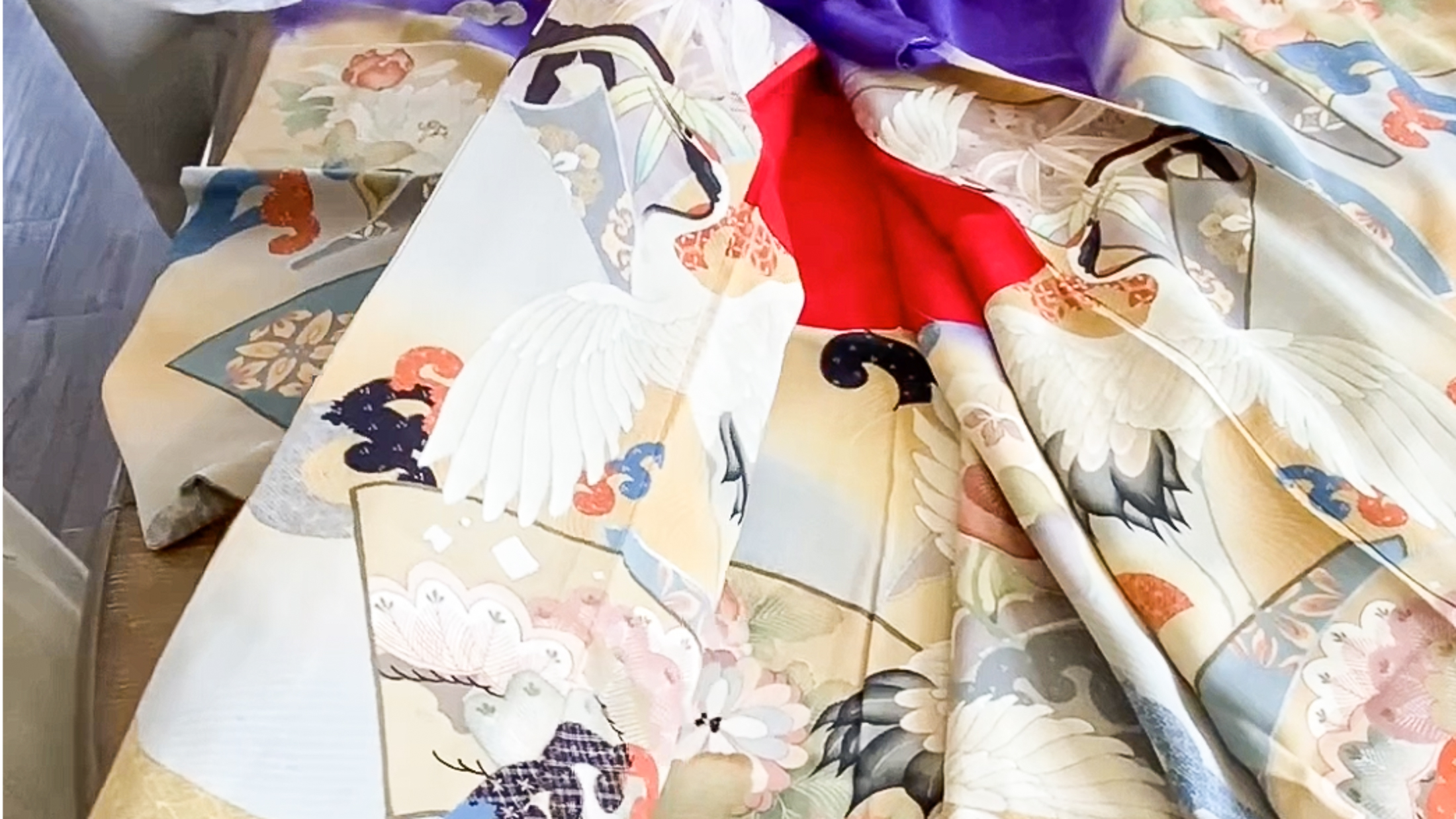
That kimono was one my client’s grandmother carried with her
when she was sent to an incarceration camp—
her own wedding kimono,
and her husband’s kimono,
packed together as part of the small bundle she was allowed to take.
What people could bring with them was limited
to only what they could carry themselves.
Why she chose to take the garments they had worn on their wedding day
has never been explained.
I learned this only later.
One day, I received an email from a woman.
“I have a question I’d like to ask.
Would there be a time when we could speak on the phone?”
When we spoke, she told me she owned an old kimono left behind by her grandmother.
She wanted to know what kind of kimono it was.
That was her initial inquiry.
A few days later, she came to my studio.
She brought with her a kimono that had been preserved so carefully
it was hard to believe how many decades had passed.
When I unfolded it, I caught my breath.
It was a wedding kimono.
Inside the same case was a maru-obi,
a formal bridal sash weighing around four to five kilograms.
It was the kind of piece rarely seen today.
She told me she wanted to wear the kimono for her own wedding.
But her grandmother had been very slender,
and the kimono was slightly too narrow for her body.
In particular,the juban worn beneath the kimono—
with its red collar—
was far too small to use as it was.
So for the inner layers only,
I used pieces from my studio,
carefully matching the color and tone of the collar
to harmonize with her grandmother’s kimono.
Over that, we dressed her in the original wedding kimono,
adjusting and padding where necessary,
until she was finally able to slip her arms through the sleeves.
After she was fully dressed,
she gently placed her hand on the fabric and said quietly,
“So my grandmother wore this.”
Her eyes filled with tears,
as if she were reaching through the cloth
to feel her grandmother’s warmth.
Inside the same case, there was one more kimono—
her grandfather’s.
Beside it were tabi socks,
now darkened to a deep brown and stiff with age.
From the size of the kimono,
it was clear her grandfather, too, had been a very slender man.
As she showed me both garments,
she wept silently, without many words.
Then she told me:
These were the kimonos her grandmother had carried with her
when she was sent to the camp—
her own wedding kimono,
and her husband’s kimono,
packed together as her personal belongings.
During World War II,
Japanese Americans were suddenly ordered to leave their homes
and sent to what are now referred to as
Japanese American incarceration camps
(often called internment camps).
What they were allowed to bring was extremely limited—
only what they could carry themselves.
Clothing, toiletries, small personal items.
Even basic necessities were scarce.
And yet, among those few belongings,
there were two wedding kimonos.
A kimono is not a practical object.
It is heavy.
It takes up space.
It is not something that helps with daily survival.
And still, she chose it.
Why, we do not know.
Perhaps she was not carrying the past with her,
but believing in the future.
That someday, someone would again wear this kimono.
Even if it was not herself—
even if it was her child,
or her grandchild,
on a milestone day of their life.
Or perhaps,
it was the only thing she could take.
And within it,
there was something
she could not bear to let go of.
That kimono crossed decades of time
and was worn once more
at her grandchild’s wedding.
The reason was never spoken.
No words were left behind.
But on that day,
it was undeniably there.
Why was a kimono inside that small bundle of belongings?
We still do not know the answer.
But one thing is certain:
A single kimono carried life forward,
crossed memory and time,
and was handed to the next generation.
I also shared a short video from this moment.
▶ Watch the YouTube Short
▶ New: Watch the YouTube Short (Grandma’s wedding kimono, worn again)
Kachou-kimono offers kimono wedding rentals, dressing,
and styling throughout California, with travel available for on-site services.
From traditional Japanese weddings
to ceremonies that incorporate family heirloom kimonos,
each wedding is approached with care and respect for its story.
▶ Learn more about Kimono Weddings
日本語のブログはこちら → こちらをクリック
Back to kimono Stories
2025
2025
@ Kachou-kimono
@ Kachou-kimono


(510) 859-3556
(510) 859-3556
follow along @kachoukimono


kachou-kimono
10201 Mountair Ave.
Tujunga, CA 91042
10201 Mountair Ave.
Tujunga, CA 91042
sachiko@kachou-kimono.com
sachiko@kachou-kimono.com
8am - 8pm everyday
8am - 8pm everyday
